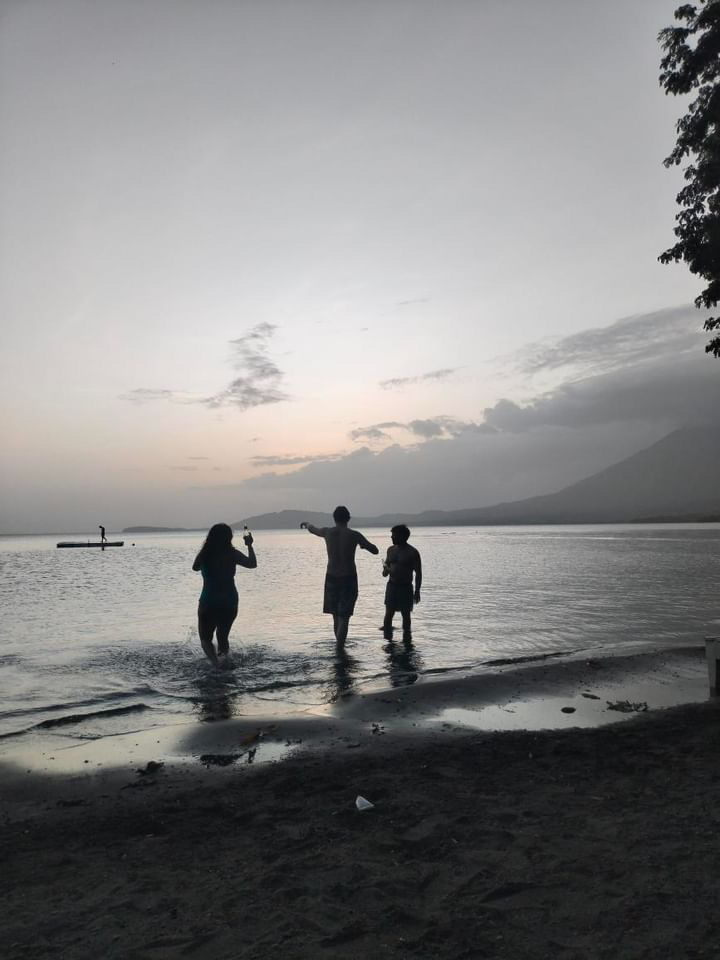
Dear reader,
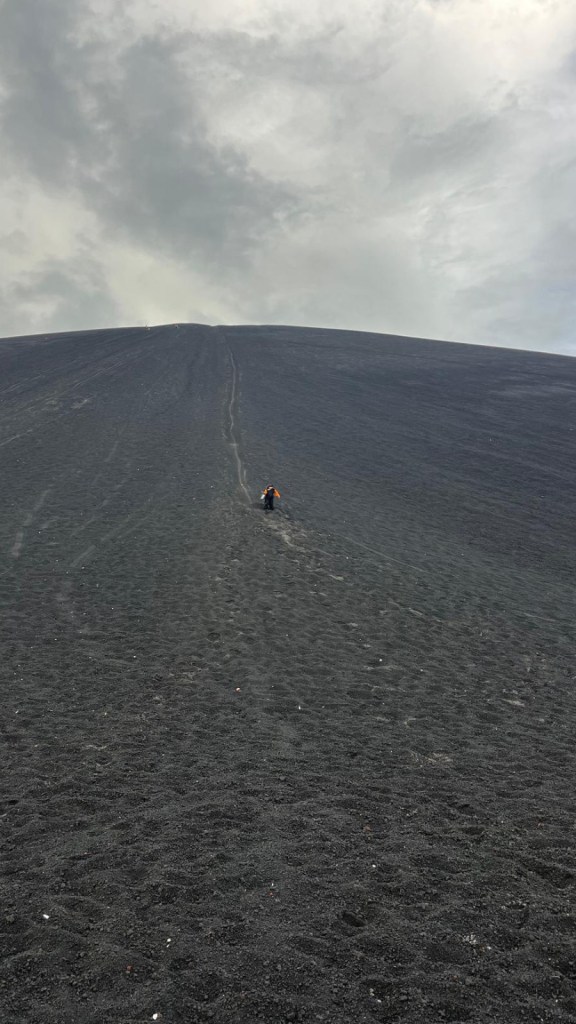
I made my new friend at the bottom of a black rock volcano. It is an almost obligatory activity for backpackers visiting Nicaragua to participate in volcano sledding. After the last of our group slid down the charcoal like gravel on our makeshift wooden sleds, our tour guides announced that I, to absolutely no surprise to myself, won the prize (punishment?) for being the slowest down the rock. Slowest, in fact, by a large margin. While the others around me chased the thrill of it all, scheming up methods to accelerate their speed, I maneuvered my descent in a rather relaxing position, doing everything possible to not garner too much velocity. A stranger burst into laughter next to me over my record breaking (record setting?) snail’s pace became our icebreaker. For a long while we managed to skip the usual round of traveler questions, which had become incredibly tired at this point.
Where are you from? Where have you been? Where are you going?
But of course, those questions caught up to us eventually. After the volcanic activity in León I made my way to Granada with a young Australian, who I will call Lach, that I had picked up in Costa Rica weeks prior. As we laid in the colorful hammocks of our quiet hostel, empty seemingly of all but us, as most occupants went in droves to an infamous jungle party. I had learned through my travels in places where Europeans tend to gather that I had grown a distaste for techno, and I have been stuck at one too many jungle parties with terrible music. As we laid there chatting, who would walk in other than Noam. He remembered me as the girl who went too slow down the volcano and was punished with fiery hot shots of liquor at the bar afterwards. I remembered him as the random man who laughed a little too hard about it alongside me.
This type of coincidence is not uncommon when backpacking. Many people follow a similar route and so you end up meeting vaguely familiar faces in vastly different places. Noam was following a similar route, and our pair briefly became a group of three as Noam traveled with us from Granada by bus, van, ferry, and rickshaw to Ometepe island.
Ometepe is a visually striking place- you arrive and are immediately engulfed by lush and greenery while being shadowed by a glorious volcano, and volcanoes are seemingly visible from every part of the island.
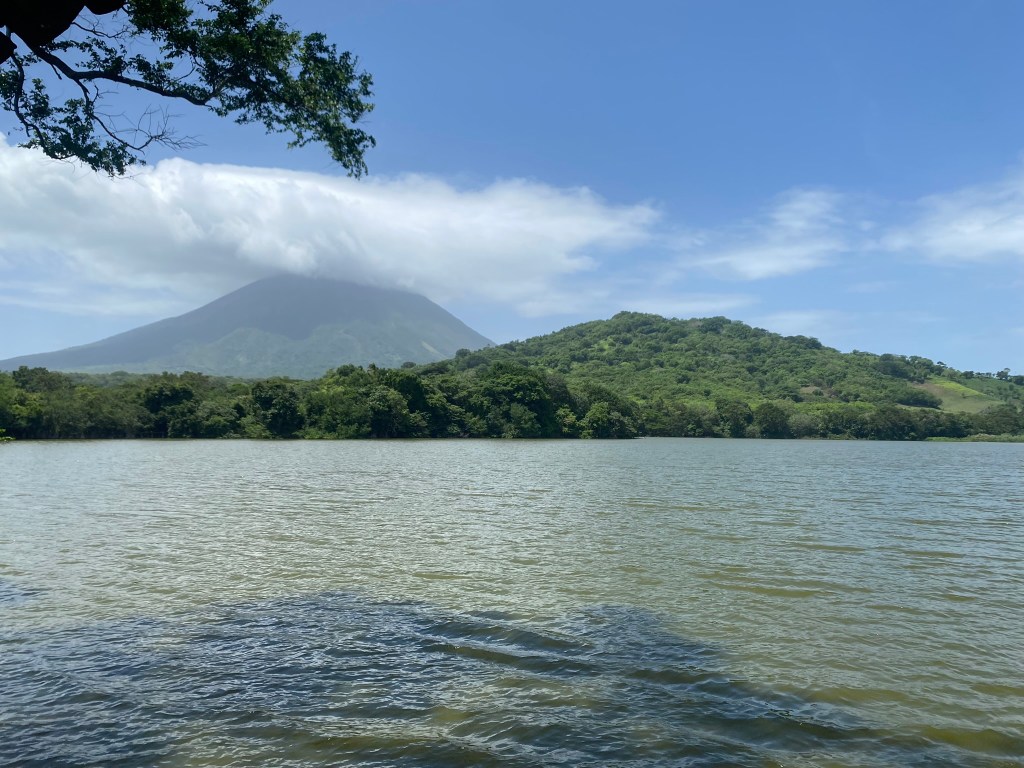
The island is filled with horses, cowboys, vegans and new age hippies. Another…unique (but becoming alarmingly less unique around the world) feature of Ometepe is that it has been overrun by a proportionally large number of Israeli nationals. I have heard rumors of similar occurrences happening in many beautiful places near water. I have seen it for myself along Guatemala’s famous Lake Atitlán, where an influx of Israelis came in not just as visitors but as people who sort of just set up shop and stayed put.
On Ometepe we participated in all the usual activities, a drum circle, yoga, meditating, and beach hopping on motorcycles. Noam had a huge toothy smile and infectious laughter, he was a skilled motorist and was inclined toward silliness, all of which are favorable qualities in a travel companion. He introduced me to Shakshuka (delicious.)
On a particularly boring hike, as it often happens, we talked a lot more about the things that we perhaps have been avoiding. Noam told me that up until a few months ago, he had been fighting in the “war” but was discharged because he was injured, and lost a significant portion of hearing in one of his ears. Now he was traveling the world with his surfboard, avoiding going back to Israel in case he was made to fight again now that he was mostly healed. The narrative I quickly made up in my mind, as one does, is that he did not want to fight again because of what I thought to be the most obvious reason: that he no longer wanted to participate in a genocide. Later, Lach theorized to me that perhaps he was simply a coward.
Later, Noam went on about how he felt like the world hated him and his country. I conceded with him that much of the world probably did and should hate Israel. Noam said that many people were using “Free Palestine” as a trend, that they don’t even know what they are saying or advocating for and just want to look good to a certain group of people. In short, they were virtue signaling. I could at least agree with him a little on that. What struck me was how matter-of-fact Noam was. He didn’t seem angry, or even overly righteous, but more so genuinely confused on how people did not understand the “plight” he, his family, and his country found themselves in. I eventually simply stated that I probably would never understand his side, and that I would also never know what it’s like actually being in the thick of it. Noam said that he did what was best for the people he loved.
A year later, when I saw how Israelis overtook San Pedro, a small indigenous village in Lake Atitlán, displacing locals and sucking out all the resources, and all while claiming to be saving the village from poverty. The justification always attempts to pain the colonizers in a better light, and I saw firsthand how dangerous these mental gymnastics were.
During my travels I started a practice of asking people that I meet who have had an impact on me, whether we travelled together for a time or had a particularly interesting conversation, to write a message in my journal. There were no rules to this other than I chose who wrote in the book. But as my friend Lach, who I had been traveling with for almost a month, was writing in it, a young woman from Tel Aviv, whom I did not even know her name, grabbed my precious book, and wrote out a whole page with written words that likely outnumbered any verbal ones we ever exchanged with each other. While companions I had known for a significant period of time were mindful, careful even, of the space they took up in the pages— aware that they were a finite resource, Miss Tel Aviv had no problem taking over space that was not offered nor willingly given. Take from that what you will.
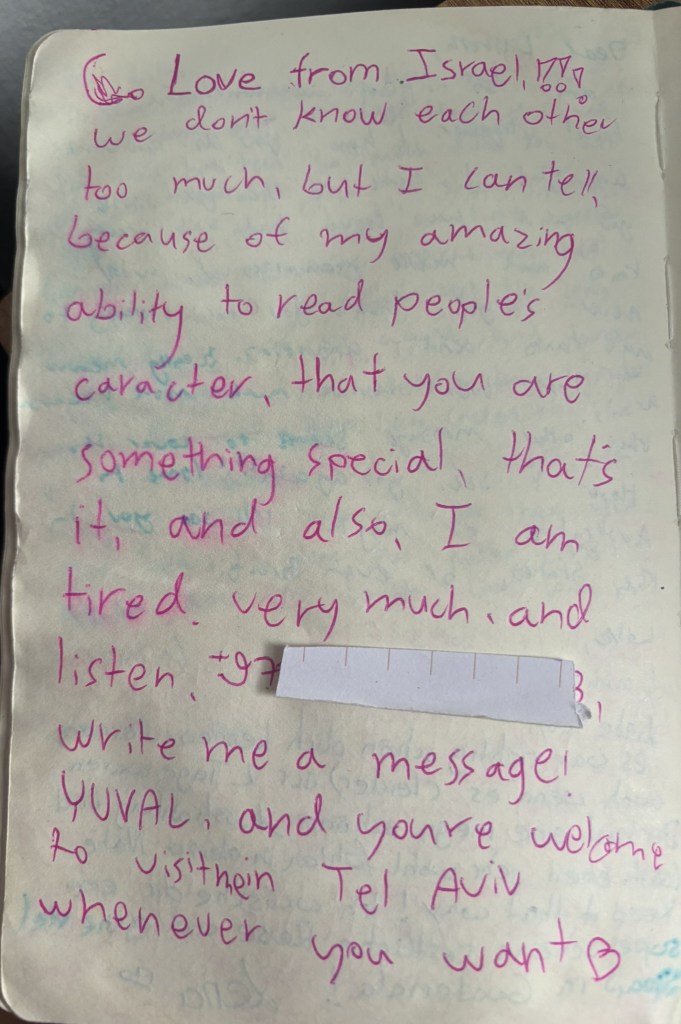
Noam had a significantly shorter message, one that I have never been able to translate:
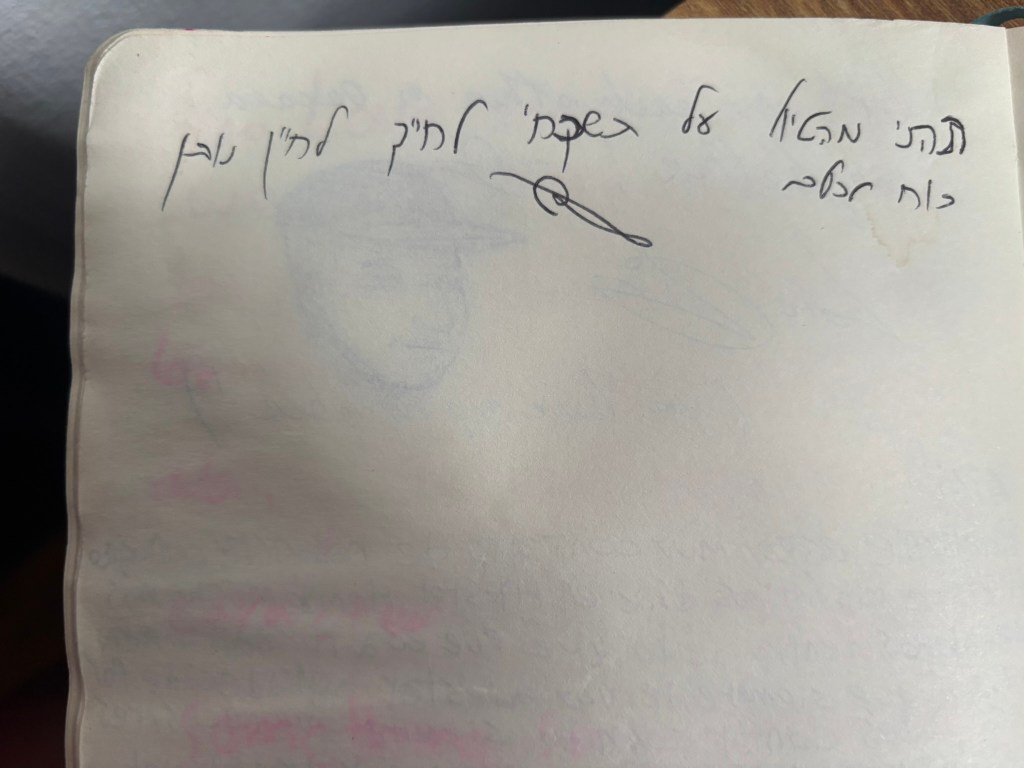
Lach remained longer on Ometepe as did Noam, both of them quite settled there for completely different reasons. Noam, likely for the dense population of his fellow countrymen, which in theory would be quite nice because when I encounter a large group of fellow Americans I tend to regard them as I would a group of potentially rabid albeit friendly-looking dogs. And Lach, because the island was also densely populated by devout vegans, which was right up his alley. Immediately after parting ways I received a facetime from Lach, cackling as he panned the camera towards Noam, who was trying to offer up a banana to a large black howler monkey hanging down from a tree.
I was headed north, on a long overland journey to Guatemala. During which, as I faded in and out of consciousness during the ride (I was unknowingly coming down with dengue fever, but that is an entirely different story), there was a lively debate between a young Canadian woman and a young Israeli man in the seat right in front of me in the small passenger van we all happen to find ourselves in. The conversation started with their shared hatred of Americans (it seems no one hates Americans quite so much as a Canadian who is mistaken for one) but the conversation really got lively after the woman felt she had adequately substantiated the difference between Americans and Canadians, namely that the former are annoying and largely dumb, while the latter not so much, when she asked innocently where her seat companion was from. As soon as he said “Israel”, she launched into the conversation that I had largely avoided having with Noam until our faithfully boring hike, and boy did she come in swinging, and I began silently championing the Canadian woman, silently, because she certainly did not need any help from me.
“So you think it’s okay to kill children?”
“Why do you keep calling it a war and not a genocide?”
On the IDF side, I remember one response distinctly: “I don’t like it, especially about the children. But if they don’t leave, unfortunately we must get rid of them. It is a shame.” There was, however, no shame in his voice. He spoke matter-of-factly, as if it were so painfully obvious.
I am reminded, and I may lose some of you here, of Avatar the Last Airbender. If you have ever seen it, you know that the eternity of the show takes place against the backdrop of war and genocide being carried out by a country called the Fire Nation. Towards the end of the series, our lovable protagonist, the sole survivor of a people completely wiped out by said nation, infiltrates one of their schools, and sees first hand the way people may come to believe with such nonchalance such insane things as “It is such a shame we have to kill them all.” Propaganda-indoctrination from birth. It is easy for someone from the outside to say, but I would never; that isn’t me. And yes, perhaps this version of you, the one who is not mandated to join your country’s militia, the one who only ever heard of Palestine or the Congo or Sudan before 2023, you would never do such a thing. However, can you be so confident that you would not succumb to it? I would like to believe that I wouldn’t, but I have believed falsities before.
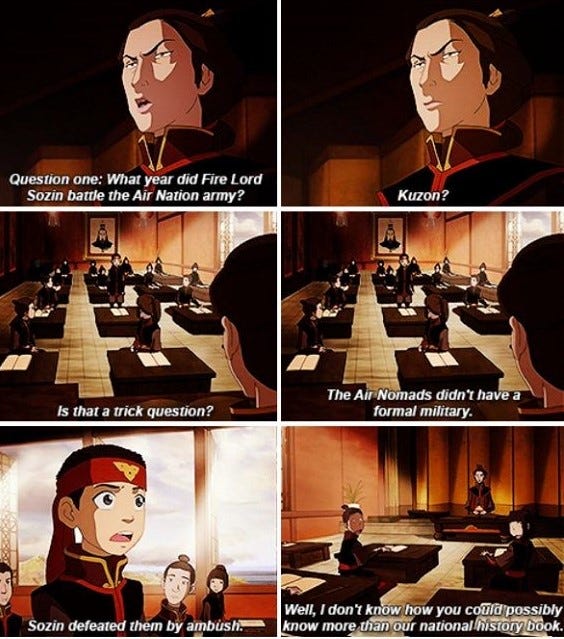
I bring up this show because it is a simple example of showing how the children of the Fire nation were not inherently evil or malicious, or out for blood, and perhaps some don’t become that way in adulthood. What they become is proud, possessive, even irrational over what they believe to be true.
People are not inherently monsters. Zionism is the monster. Fascism disguised as nationalism is the monster. Capitalism is the monster, and the only thing to do with a monster is defeat it or let it devour you. The rest are simply henchmen. Henchmen, in theory, can be reasoned with. People are malleable, impressionable, prone to following their emotions, however misguided. Scary? Yes, people are terrifying. For the longest time I thought I hated people. But through my travels I have seen that, generally, people all want basically the same things. The outliers, the truly hateful and harmful, are powerful through money and audacity, and while they may run the government and the armies and the companies, they do not actually outnumber the rest of us. But what is the cure to long withstanding brainwashing, indoctrination, and fascism?
Well, of course, I don’t know, if it were that easy we would not be in the state that we are in now.
But when the feisty Canadian woman disembarked in El Salvador, the Israeli man was the only person she bid a farewell to, not out of fondness but out of familiarity.
So…is that it? The big lesson I learned after four days of traveling with an ex-IDF soldier is that oh, they’re people too? Dismantling must go beyond an individual, the problem is systematic, purposefully so large that it feels inevitable? Lessons one could learn from a children’s cartoon? Yes. But also, no. And also, I don’t know. However, my stereotypically Americanized narrow vision widened, and I began to notice more troubling ripple effects. Where a group of people may be emboldened to conquer where and what they see fit, whether it is a page in a journal, a volcanic island in Nicaragua, or entire towns in rural Guatemala.
I don’t know if Noam is still catching waves around the world, or if he returned to Israel, or if he settled into a beautiful place by the water. I hope it is the former, because it is the least violent option.
Sincerely,
Lili
 Elsewhere Letters
Leave a comment